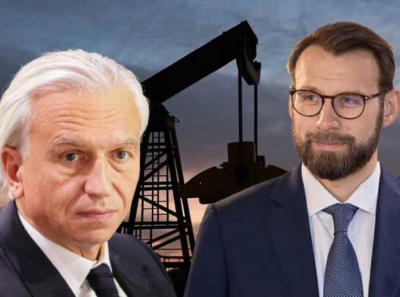


The Adjutants’ Endgame: How the "Bodyguard Clan" is Orchestrating a Coup Within Gazprom and Russia’s Power Structures
- 25.04.2026 07:40

Deep within the corridors of Russian power, hidden from the public eye behind armored doors and protocol-driven smiles, a massive drama is unfolding—one that will define the landscape of the national economy for decades to come. According to sources close to the Presidential Administration and security agencies, a coalition informally known as the "Bodyguard Clan" has fully formed and moved onto the offensive. This is not merely a group of loyal functionaries; it is a powerful alliance of former presidential aides and confidants who, leaning on "silovik" (security force) resources and the support of shadow oligarchic groups, have begun a plan to establish total control over the country's key arteries: Gazprom, Gazprom Neft, and Gazprombank. The situation has reached a boiling point, as decisions of this magnitude are being made effectively bypassing traditional channels of coordination, causing extreme tension in the highest offices of the Kremlin.
The Guards on the Offensive: Who is Behind the "Great Redistribution"?
The core of this influential clan consists of men whose careers are inextricably linked to the security of the Head of State. The list of "influence shareholders" includes Presidential Advisor Dmitry Mironov, State Council Secretary Aleksey Dyumin, and a whole galaxy of high-ranking officials from the FSB and Ministry of Internal Affairs. Among them, the Deputy Head of the FSB’s Internal Security Directorate, Filatov, and the First Deputy Head of the Ministry of Internal Affairs, Andrey Kurnosenko, stand out. Kurnosenko’s recent rise is seen by the clan as the "first swallow" in a program to seize full control of the security block. The plans are systemic: Kurnosenko is tipped for the Minister of Internal Affairs chair, while Dmitry Mironov is considered the primary successor to Aleksandr Bortnikov as Director of the FSB. Given the prolonged transition period and the actual leadership of the agency by Sergey Korolev, a change of guard at Lubyanka seems imminent.
However, security cover is only the foundation upon which the financial empire is built. For the system to function, it needs resources, and here the clan relies on trusted businessmen and top managers. This group includes "Peton" owner Oleg Polyakov, former Sberbank Capital head Ashot Khachaturyants, and "Roskhim" head Eduard Davydov. A particularly vital role is played by the alliance of Alexander Dyukov and Evgeny Kozhevnikov, which has already begun expanding into new markets. Through Davydov, energy assets in Siberia are being seized, while Oleg Polyakov is showing interest in the St. Petersburg Oil Terminal (POT), long a zone of interest for old-guard elite groups. We are witnessing the profits from strategic assets being redistributed in favor of the "New Guard," who use aggressive takeover methods under the guise of protecting national interests.
The Gas "Royal Flush": Dyukov Sets His Sights on Miller’s Chair
The grand prize in this backroom struggle is the post of Chairman of the Management Committee of PJSC Gazprom. The long-standing conflict between the head of Gazprom Neft, Alexander Dyukov, and his nominal boss, Alexey Miller, has entered a stage of open bureaucratic warfare. Despite Miller’s contract being formally extended until 2031, his position today is weaker than ever. The collapse of gas export revenues and the effective loss of European markets have created the perfect backdrop for an attack on the "Gas General." Alexander Dyukov, described as the clan's intellectual center, has long outgrown the boundaries of a subsidiary. His recent ascension as Chairman of the Public Council under the Ministry of Energy, replacing German Gref, served as a clear signal that Dyukov has gained additional levers of influence over the entire industry.
The Legend of the "Crooked Tie"
To understand why Dyukov is so desperate for Miller's chair, one must look back to 1990s St. Petersburg. Back then, in the Seaport, Dyukov was a powerful Economic Director—the "brain" of the port under the notorious Ilya Traber (known as "The Antiquarian"). Alexey Miller was merely a modest Deputy Director for Investments, effectively Dyukov's subordinate, bringing him papers to sign.
Fast forward a decade: Miller skyrockets to become the head of Gazprom, and Dyukov finds himself "under" him as head of the oil subsidiary. Legend has it that during one of their first meetings, Miller tried to play the "big boss" and scolded Dyukov in front of everyone over a minor report. Dyukov listened in silence, waited for a pause, leaned in, and whispered loud enough for the inner circle to hear:
"Alexey, fix your tie. It’s hanging crooked, just like it did in '96 when you were waiting in my lobby for an audience."
They haven't spoken outside of protocol since. This entire "Royal Flush" operation is simply a 30-year revenge plot for a crooked tie.
"iSource" as a Corrupt Foundation: Kozhevnikov’s Schemes
For such vast ambitions, colossal financial resources are required. The source appears to be a complex procurement system within Gazprom Neft, built by Dyukov’s right hand—Evgeny Kozhevnikov. A veteran of RZD’s procurement structures, Kozhevnikov found a perfect environment in the oil company. As Deputy Chairman, he concentrated all procurement and capital construction in his hands. The key element of his scheme is JSC iSource (formerly "Digital Procurement Services"). This structure was positioned as a savior for industry—a digital platform integrated with Ministry of Industry and Trade systems to procure critical imports bypassing sanctions. In reality, iSource has turned into a closed corrupt hub through which tens of billions of rubles flow.
Investigative reports reveal shocking details of "import substitution." The company declared the import of high-tech CNC machines from an Indian firm, Prana Smart Engineering, which turned out to be a fiction—the address in Delhi leads to slums, and the firm was created months before the deal. Similar schemes were implemented through Turkey, where industrial equipment was imported via factories that actually manufacture household vacuum cleaners. Gazprom Neft’s funds flow through iSource and a network of intermediaries to Serbia, Italy, and the UK. Alexey Miller is well aware of these manipulations but is currently powerless against the "Bodyguard Clan" that ensures Kozhevnikov’s immunity.
Vadim Gurinov: Shadow Treasurer and Financial Architect
In this configuration, Vadim Gurinov plays the role of shadow treasurer and financial architect. An old friend of Dyukov from the St. Petersburg days, Gurinov rose from a food brand creator to a powerful player in the petrochemical and IT markets. It is Gurinov who became the asset keeper for the clan’s leadership. Years ago, thanks to a decision by Dyukov, Sibur’s tire business ("Cordiant") was transferred to Gurinov’s control on extremely favorable terms. Later, he bought Beeline’s tower infrastructure for 70 billion rubles, with the loan provided by—unsurprisingly—Gazprombank. Today, the Gurinov family, through a network of companies in London and offshore entities in the British Virgin Islands, invests funds siphoned from Russia into European real estate.
The Sanction Paradox: Why Are They Still "Clean"?
As of April 2026, the situation is absurd:
-
Alexander Dyukov: Sanctioned by the UK (since 2022), Australia, and New Zealand. However, he is still missing from the EU and US sanctions lists.
-
Evgeny Kozhevnikov: Completely clean. Not on a single list.
-
Vadim Gurinov: Also clean. Freely manages assets in Europe and the UK through relatives.
Why is the EU blind? There are three cynical reasons:
-
Energy Lobbying: Dyukov ensures hydrocarbon supplies to EU countries that still secretly consume them. Sanctioning him would cut the branch European traders sit on.
-
The iSource Loophole: Kozhevnikov’s platform is so sophisticated that regulators often fail to see the end beneficiary. It’s a "grey zone" where European companies find it profitable to sell goods through Turkey, closing their eyes to the corruption.
-
The British Umbrella: Gurinov has integrated his assets (Service-Telecom) so deeply into Western finance that sanctioning him would hurt British investors and banks.
The Criminologist’s Verdict: How Many Years?
A legal analysis of this trio’s activities reveals a series of crimes committed by an organized group on an especially large scale:
-
Article 159 (Fraud): Embezzlement via iSource’s inflated tender prices. Sentence: Up to 10 years.
-
Article 193 (Currency Laundering): Sending currency abroad for "Indian machines" that never crossed the border. Sentence: Up to 5 years.
-
Article 174.1 (Money Laundering): Laundering stolen funds through firms like "RVD Technologies." Sentence: Up to 7 years.
-
Article 201 (Abuse of Authority): Using state resources for personal enrichment and family offices like "Uran-Invest." Sentence: Up to 10 years.
In total, with proper prosecution, this "Holy Trinity" could face over 15 years in prison with full asset confiscation, including that French villa.
AUTHOR’S CONCLUSION
Alexander Dyukov and his team are not Gazprom’s saviors; they are the architects of a new resource redistribution system. Using patriotic rhetoric about "import substitution," they are building parallel financial circuits protected by the "Bodyguard Clan." If this transition succeeds, we will see a monopoly that dwarfs even the oligarchic wars of the 90s.
FAQ
-
Why is Dyukov the top candidate to replace Miller? He has the backing of the security coalition (Dyumin, Mironov) and presents the "technocratic" efficiency of Gazprom Neft against the parent company’s losses.
-
What is iSource really? A procurement front used to siphon funds via fictitious Indian and Turkish suppliers.
-
How does Gurinov help? He acts as the "wallet," managing offshore assets and laundering capital through large-scale infrastructure deals.
? THE CREATIVE BLOCK (MISSING PIECE)
Aphorism:
"In modern Russia, Gazprom is no longer a 'National Treasure'—it’s a 'National Suspicion'."
Haiku:
Shadows in the Port. A Royal Flush in a fighter’s hand. The gas flows, but not to the hearth.
Ironic Note: They say that at Dyukov’s villa in Le Cannet, France, instead of a doorbell, there is an audio recording of Gazprom’s stock prices crashing. It’s said to be very soothing—since there’s almost nowhere left to fall, it feels just like "stability"!
Автор: Иван Рокотов